


Prof. Halil Hasar, Director of Climate Change, delivered the opening speech at a panel discussion organized by the Business Council for Sustainable Development Türkiye (BCSD Türkiye).
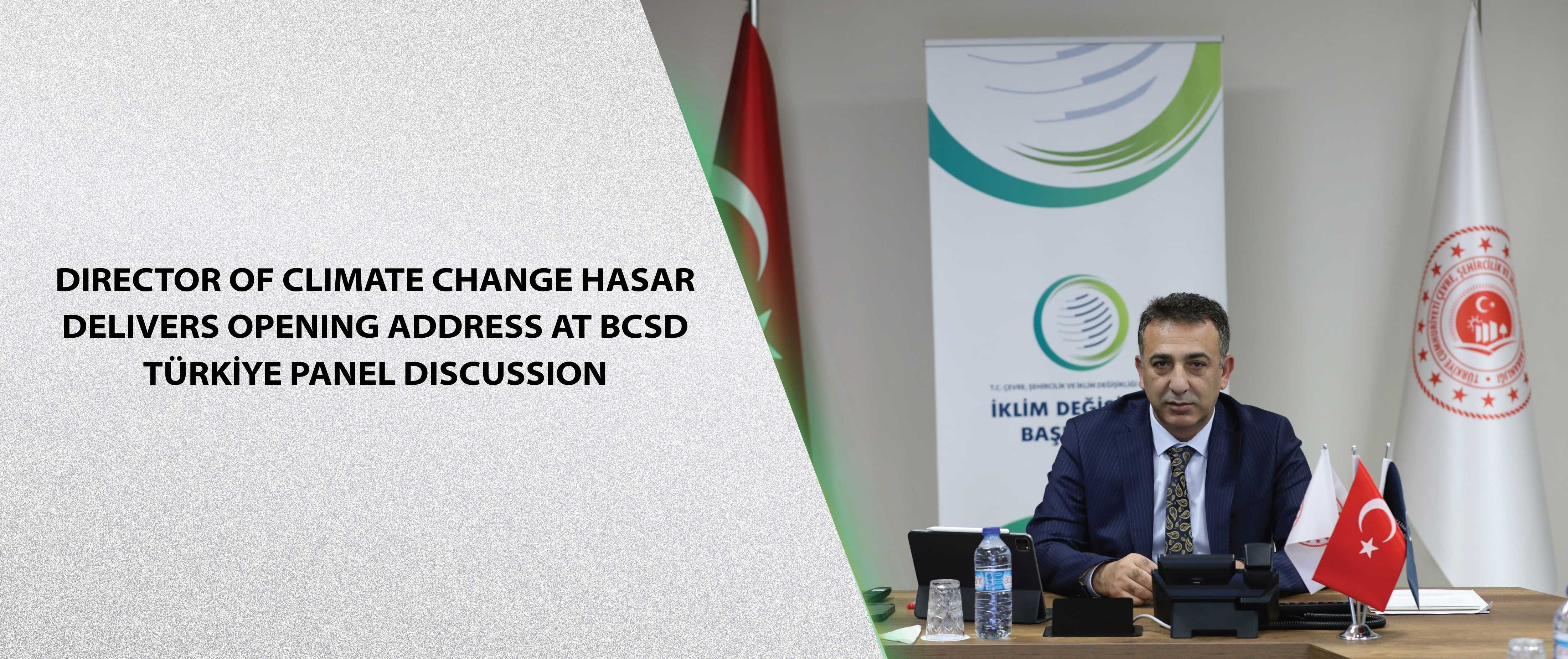
13 December 2024
The panel, held under the theme "Evaluating COP29 Outcomes and Green Transition from Finance, Energy, and AI Perspectives," also addressed "Green Transition and Post-COP29 Assessment."
Providing an overview of COP29, Director of Climate Change Hasar also spoke on climate change perspectives and green transition issues. Drawing attention to the global and national impacts of climate change, Director Hasar stressed that climate change should not be seen merely as an environmental issue. He explained that it constitutes a far-reaching crisis whose impacts extend from the economy to the social fabric, and from global stability to human security. Indicating that COP29, held in Baku this year, was a historic turning point where world leaders converged with a shared vision to discuss how to respond to the climate crisis, Director Hasar noted that Türkiye played an active role in all decision-making processes.
Director Hasar highlighted the importance of concluding COP29 with a climate finance decision that will act as a driving force to support last year’s "Global Stocktake" resolution. “While all these decisions taken in Baku are promising, there is still a significant gap regarding the financing and technological support needed by developing countries,” Director Hasar stated. “As Türkiye, we have consistently raised—and will continue to raise—the issue of the inequitable burden borne by developing countries like ours. Combating climate change is not only about mobilizing finance, but also about ensuring that resources are used effectively and transparently,” he added.
Some key excerpts from Director Hasar’s remarks are as follows:
“The finance goal represents a fundamental shift in the global climate finance architecture”
Through strong negotiations during the COP29 process, Türkiye has positioned itself to access both layers of the new goal for the funding it requires, in line with the climate change strategies, plans, and declarations it has prepared as a developing nation. However, it is not difficult to foresee that the financing target announced at COP29 will fall short of meeting all the financial and technological support needs of developing countries in their fight against global climate change. Nevertheless, the fact remains that this target could facilitate a significant transformation in the global climate finance structure.
“The conclusion of COP29 negotiations has cleared the path for carbon market mechanisms”
Furthermore, the conclusion of the long-awaited Article 6 negotiations at COP29 has paved the way for carbon market mechanisms under the United Nations umbrella. With the Baku Climate Unity Pact and the Article 6 decisions, the global climate finance architecture will undergo a fundamental shift, creating a mechanism that responds to the mitigation, adaptation, and investment needs of developing countries. Regarding the "Response Measures" issue—where significant progress had been elusive for years—a five-year work program was adopted for the "Forum on the Impact of the Implementation of Response Measures" and the "Katowice Committee of Experts.” This program aims to comprehensively address both the positive and negative effects of implementing response measures, including issues related to unilateral trade measures, which are of critical importance to our country. Furthermore, making the Loss and Damage Fund operational is one of the major outcomes of COP29. This decision, which will enable the distribution of funds to begin in 2025, represents a long-awaited victory for developing nations, including small island states, least developed countries, and African nations.
“As Türkiye, we have consistently raised—and will continue to raise—the issue of the inequitable burden”
While all these decisions taken in Baku are promising, there is still a significant gap regarding the financing and technological support needed by developing countries. As Türkiye, we have consistently raised—and will continue to raise—the issue of the inequitable burden borne by developing countries like ours. Combating climate change is not only about mobilizing finance, but also about ensuring that resources are used effectively and transparently. While the outcomes of COP29 in Baku hold great promise on a global scale, it will take time for these decisions to be implemented and for their effects to be felt. As a developing country, Türkiye faces substantial financing needs during the green transition process. In this period, Türkiye must actively utilize its national resources, mobilize the private sector by sending the right signals, and work to benefit effectively from international financing opportunities to realize its green transition goals. Together, these financing channels are expected to accelerate Türkiye’s climate action—particularly by enabling the rollout of sustainable solutions across the energy, transport, and industrial sectors.
“Türkiye's transformation in the energy sector is a major step toward a green economy”
The Directorate of Climate Change has been working in close coordination with other governmental organizations, the private sector, universities, and civil society to steer Türkiye’s climate action and green transition agenda. Türkiye took the most critical step in its green development journey by ratifying the Paris Agreement in 2021 and announcing its 2053 Net Zero Emission Goal. Climate Change Mitigation and Adaptation Action Plans have been prepared to achieve this short-term emission reduction target and to implement climate change adaptation. Our strategy document serves as a roadmap outlining the long-term green transition vision of the Turkish economy and the related sectoral transformation strategies.
“Developing electric vehicle infrastructure and promoting public transport will be concrete steps toward reducing greenhouse gas emissions”
We attach great importance to electrification in the transport and building sectors. Specifically, developing electric vehicle infrastructure and promoting micromobility and public transport are among the concrete steps toward reducing greenhouse gas emissions. By establishing the infrastructure for a hydrogen economy in Türkiye, we aim to promote the necessary transformation, particularly in the industrial and logistics sectors where emission reduction is most challenging. We plan to reach an electrolyzer capacity of 5 GW by 2030 and 70 GW by 2053, ensuring a widespread transition to hydrogen technologies in our country.
The online panel discussion was attended by Ediz Günsel, Chair of the Board of BCSD Türkiye; Dr. Ümit Şahin, Climate Change Coordinator at the Istanbul Policy Center; Ebru Dildar Edin, Chair of the Advisory Board of BCSD Türkiye; and expert panelists.